Indigenous Peoples Social Justice and Culture
A groundbreaking initiative that preserves the social, cultural, and political dimensions of Indigenous communities around the world, through original voices.


A groundbreaking initiative that preserves the social, cultural, and political dimensions of Indigenous communities around the world, through original voices.

Mainstream coverage rarely captures the complexity of Indigenous life. Here, Indigenous creators take the lead. Their voices appear exactly as sourced—not filtered through traditional media platforms.
The project covers more than a thousand organizations worldwide and includes blogs, digital magazines, videos, podcasts, online newspapers, and other materials that convey real experiences, heritage, and activism.
By centering on new media, this project lifts up voices that traditional collections miss, capturing Indigenous conversations and stories as they unfold—immediate, honest, and grounded in lived experience. This content pushes back against stereotypes, corrects misinformation, and makes a stronger case for equity. It’s a resource built for real-world impact.
Approximately 200,000 pages are preserved in a permanent archive for future scholars and advocates. Included are the restored records of many organizations, significant in their times, that have ceased to exist due to loss of funding, political pressure, or censorship.
Prioritized is the preservation of at-risk content from regions where political instability, silencing, or systemic oppression threaten its survival—the voices of the Crimean Tatars, the Wet’suwet’en, and the Ainu are examples.
Indigenous Peoples Social Justice and Culture safeguards content against erasure, preserves history, and serves as a catalyst for understanding and honest dialogue. Critical stories and cultural expressions can endure as a testament to resilience and resistance.
To support Indigenous scholarship and cultural preservation, American Indian College Fund members have free access to Indigenous Peoples’ Social Justice and Culture, helping students and faculty engage with the voices, struggles, and achievements of Indigenous communities.
items indexed so far
A "living collection" that continually grows — and a 200,000-page permanent archive.
organizations
Organizations from over 100 countries.
Sample covers, pages, and primary sources from this Database.
Montagnard people in Vietnam protesting religious persecution
MEET THE EDITORS

French Algerian American playwright and librettist
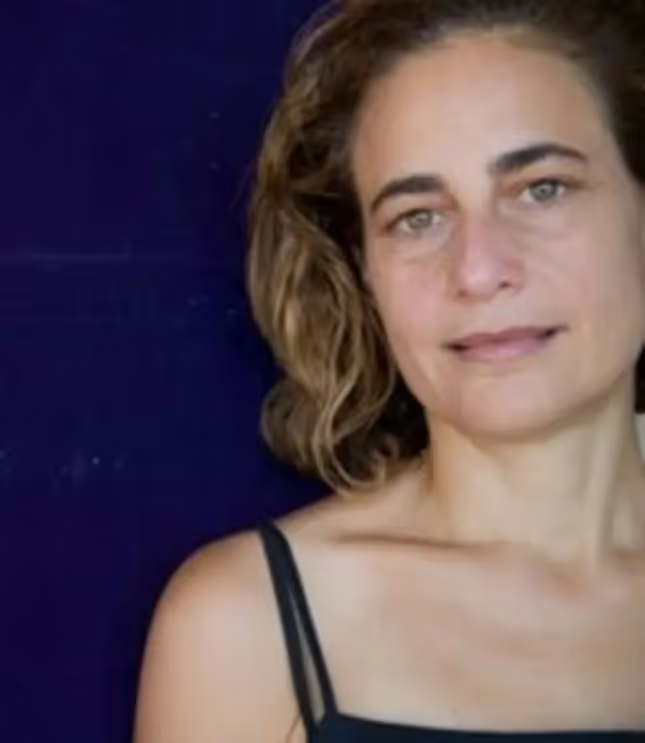
CATHERINE FILLOUX is an award-winning French Algerian American playwright and librettist, who has been writing about human rights for decades. Her plays and operas have been produced nationally and internationally. In New York City, Filloux’s new musical “Welcome to the Big Dipper” (composer Jimmy Roberts) premiered Off-Broadway at the York Theatre, and her play “How to Eat an Orange” premiered at La MaMa Downstairs Theatre. Catherine’s new play “White Savior” was nominated for The Venturous Play List. Her other recent plays include: the livestream web drama “turning your body into a compass” at CultureHub, NYC; “whatdoesfreemean?” at Nora’s Playhouse, NYC; “Kidnap Road” at La MaMa, NYC; “Selma ‘65” in NYC and on a US tour; “Luz” at La MaMa; and “Looking for Lilith” in Louisville, KY. Catherine is the librettist for four produced operas. “Orlando” (composer Olga Neuwirth) is the first opera at the Vienna State Opera by a woman composer-librettist team (2022 Grawemeyer Award). The opera “Where Elephants Weep” (Chenla Theatre, Cambodia, composer Him Sophy) broadcast on Cambodian national TV and Broadway on Demand. Filloux has traveled for her plays to conflict areas including Bosnia, Cambodia, Guatemala, Haiti, Iraq, Morocco. She’s been to Sudan and South Sudan on an overseas reading tour with the University of Iowa’s International Writing Program. Catherine received her French Baccalaureate in Philosophy with Honors in Toulon, France. She has spoken for media and organizations around the world

Jeanne Hoffman Smith Professor Associate Professor
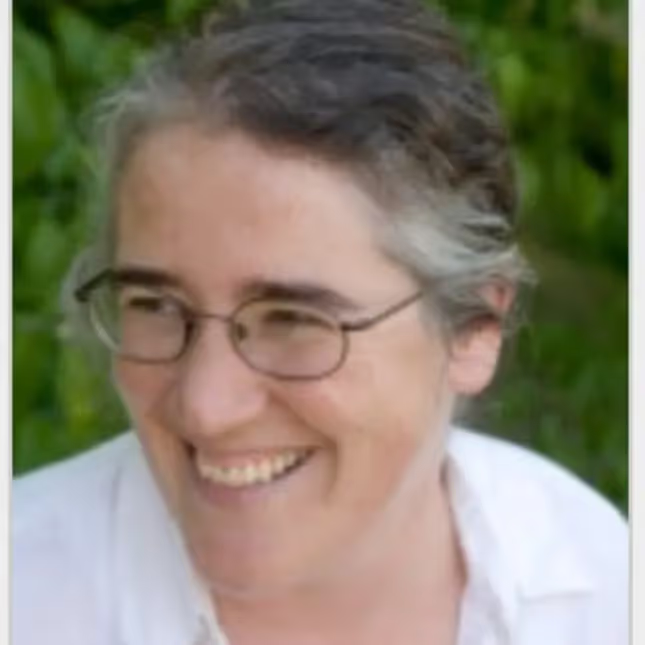
Professor Hearne's teaching and research center on Native American and global Indigenous media studies, archival recoveries of Indigenous presence in cinema history, and contemporary digital media, digital storytelling, and animation. She teaches courses on Global Indigenous Media, History of Animation, History of Documentary, the Short Film, and Westerns, as well as FMS core courses including Introduction to Film & Media, Film Theory, Film History I and II, and the Capstone.
Her books argue for the centrality of Indigenous images and image-making to American film history. She is the author of Native Recognition: Indigenous Cinema and the Western and Smoke Signals: Native Cinema Rising and the co-editor of the collection ReFocus: The Films of Wallace Fox. She also served as a guest editor for the May 2017 special issue of Studies in American Indian Literatures on “Digital Indigenous Studies: Gender, Genre and New Media” and the Winter 2021 Journal of Cinema and Media Studies In-Focus dossier, “Indigenous Performance Networks: Media, Community, Activism.”
Before joining Film and Media Studies at OU, she taught for many years at the University of Missouri where she was the founding director of the Digital Storytelling B.A. degree program, a William T. Kemper Fellow for Teaching Excellence, and a National Endowment for the Humanities Fellow. In 2019 she served as the Fulbright Canada Research Chair in Culture and Society at the University of Alberta.

Apani Blackfoot Digital Library Liaison
University of Lethbridge, Lethbridge, Canada
Apani Blackfoot Digital Library Liaison, University of Lethbridge, Lethbridge, Canada
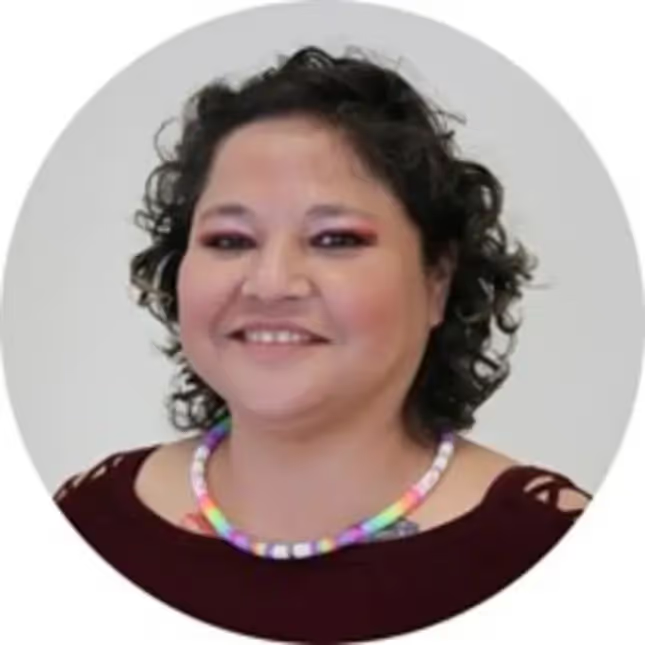
Danielle is a member of the Kainai tribe of Alberta. She has worked on repatriations for her tribe and for the Grande Ronde of Oregon. Danielle has been building the Blackfoot Digital Library since 1995. She is a Beaver woman and cares for a Beaver Bundle.

Native American Studies Librarian
University of California, Berkeley
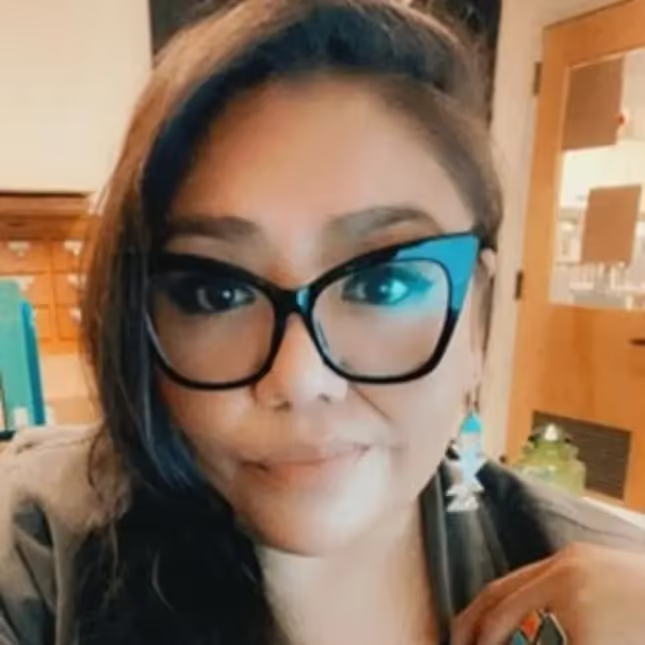
Melissa Stoner (Diné) has been the Native American Studies Librarian at the University of California, Berkeley, since June 2016. Melissa graduated from San Jose State University with a Masters of Library and Information Science. She is currently the Outgoing Chair of the Society of American Archivists (SAA) Native American Archives Section and a member of the SAA Archival Repatriation Committee. Her focus is the arrangement, description, and digitization practices of Indigenous archival materials that may contain culturally sensitive information and/or Tribal knowledge.
IP, EZproxy, Shibboleth, OpenAthens, HAN.
Full VPAT statement available.
Indexed in Primo, Summon, EDS, WorldCat.
Quarterly updates via Customer Portal.
COUNTER 5 / SUSHI compliant.
Free 30-day institutional trial. No credit card required.